Top 5 Tips for Building a Higher-End Custom Home
17th August 2026
Pre-Construction Post-Construction First Home Buyer Investor Upsizing & Downsizing Design & Trends
Planning a higher-end custom home? Discover five tips on choosing a builder, setting your budget, designing for your lifestyle and finalising selections.
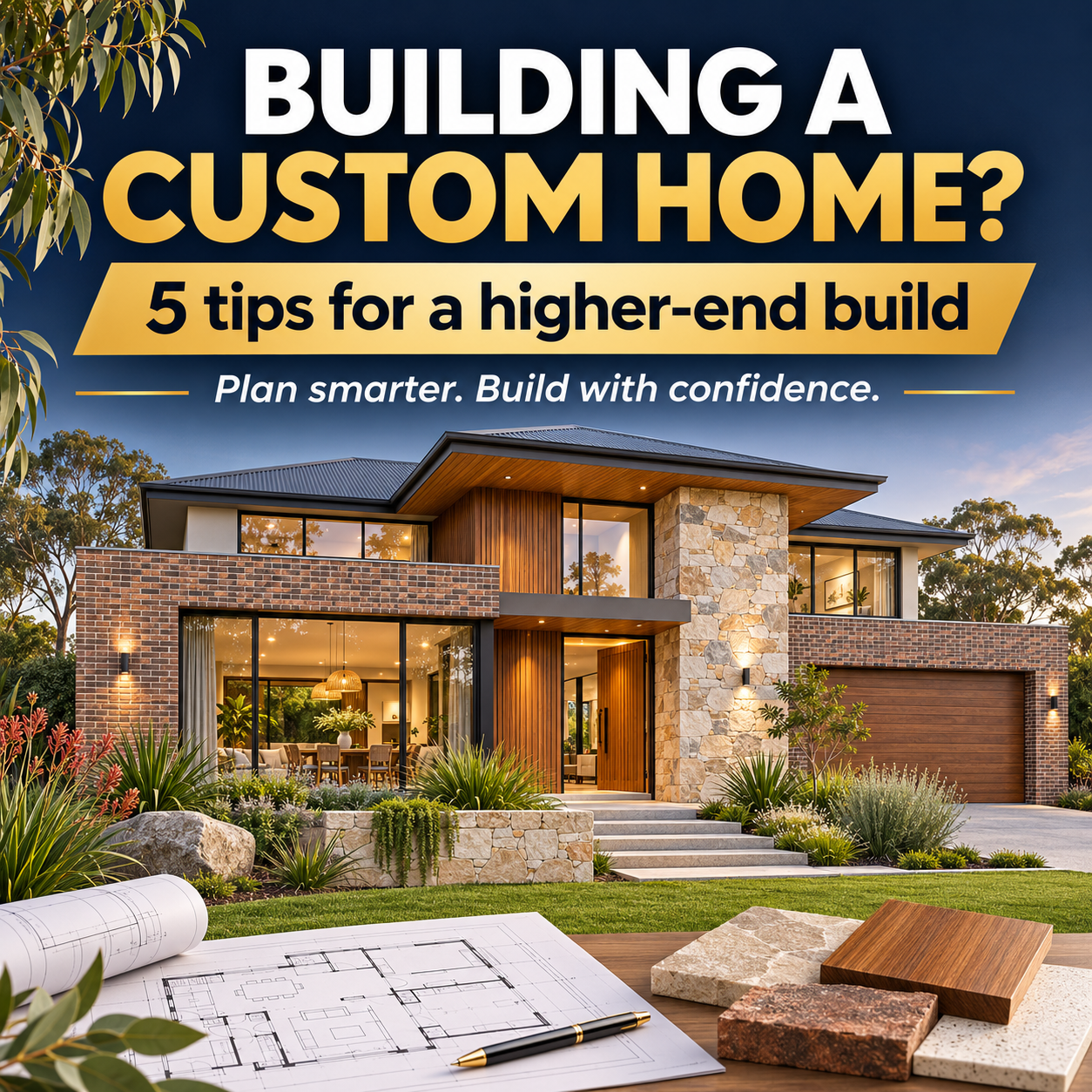
Top 5 Tips for Building a Higher-End Custom Home
Building a higher-end custom home gives you the opportunity to create something that suits the way you live. But with that flexibility comes a long list of decisions about design, budget, materials and who you trust to bring everything together.
Where should you start? Should you speak with an architect or a builder first? And how do you stop your dream home from becoming a design you cannot afford to build?
In this episode of the Home Building Hub Podcast, Colin Bischof and Darren Brennan speak with Nathan Owen from Ground Floor Building Coach. Drawing on his residential building background, Nathan shares practical ways to approach a custom build with clearer expectations and a stronger team.
Here are five key tips from their conversation for Australians planning a higher-end custom home.
1. Choose a custom home builder for the experience as well as the finished house
Beautiful project photos can help you discover builders whose work you like. But they do not tell you everything about the experience of building with them.
Nathan encourages buyers to look beyond polished social media images and ask how a builder will guide them through the project. A custom build can involve a lengthy relationship, starting well before construction begins. Communication and organisation matter throughout that journey.
Questions to ask a potential builder
- Have you built homes similar to the style and complexity we want?
- How will you keep us informed during design and construction?
- Who will be our main point of contact?
- How do you record decisions, selections and changes?
- Can you show us an example of your quote presentation?
- Do you use a client portal or project management system?
Nathan sees pride in past work, award entries and a willingness to improve business systems as useful signals. However, no single signal tells the whole story. The conversation should also show whether the builder listens to your needs and can explain their process clearly.
The practical takeaway: Look for a builder whose experience fits your project and whose approach makes you comfortable asking questions.
2. Involve your builder early in the design process
One of Nathan's strongest recommendations is to involve a suitable builder before committing to a fully developed design.
His preference is to speak with the builder first, establish realistic parameters, then work with an architect or building designer. This is his recommended approach, rather than a rule that every custom project must follow.
The aim is collaboration. Early builder input can help connect your ideas with the practical realities of construction and cost.
Give your design team a clear brief
Before detailed drawings progress, work through:
- Your preferred spending range and maximum budget.
- The approximate home size you are considering.
- The number and type of rooms you need.
- Your preferred materials and level of finishes.
- Your priorities for comfort, energy performance and style.
- Site features that may affect the design or construction approach.
Nathan also highlights the value of matching your team to your project. A builder experienced in large glass openings and concrete construction may offer a different fit from one focused on compact, energy-efficient homes.
Understand the value of paid pre-construction input
Meaningful estimating and design feedback take time. Nathan argues that a builder's consulting work should be treated as a professional service.
In the episode, he uses an illustrative example: discovering a major budget mismatch after an early concept and estimate can be less costly than finding it after spending much more on detailed documentation.
The lesson is to check feasibility while changes are still easier to make. Ask what a pre-construction service includes, what it costs and what information you will receive.
3. Set an honest budget for the whole project
There is a big difference between a budget for the house itself and a budget for the complete project.
Nathan explains that buyers can focus on kitchens, living spaces and finishes while overlooking costs outside the home's footprint. Colin also recommends explaining both what you would like to spend and the maximum you cannot exceed.
That gives the team a clearer basis for discussing compromises.
Separate the main budget categories
The episode highlights costs such as:
- House construction.
- Design and documentation.
- Engineering and council-related fees.
- Driveways and fencing.
- External steps and access requirements.
- Scaffolding where required.
- Water tanks or wastewater systems where relevant.
- An agreed reserve for unresolved costs and unexpected items.
These items will vary between projects. The important question is whether your budget includes them, rather than assuming they are covered by the house price.
Nathan's point about giving the designer a more conservative budget is best understood as setting a defined design allowance after other project costs have been identified. Make that allocation clear to everyone involved.
Use early estimates to test your priorities
If the initial concept exceeds your budget, the discussion might involve reducing floor area, simplifying the design or adjusting materials.
A smaller home with the spaces and finishes you value most may be a better fit than a larger design that forces compromises everywhere else.
The dollar figures and square-metre rates discussed in the episode are examples from that conversation, rather than a current pricing guide for Australian custom homes.
4. Design your custom home around how you actually live
Custom design is an opportunity to question what you need, rather than simply copying features from a display home or television programme.
Nathan encourages buyers to think about daily routines, the site, orientation and ongoing maintenance. A home should work for its occupants long after the excitement of choosing finishes has passed.
Start with lifestyle questions
- Do you enjoy cooking enough to make the kitchen a central feature?
- Do you regularly entertain indoors and outdoors?
- Would your family use larger shared living spaces more than oversized bedrooms?
- How much outdoor space will you realistically maintain?
- Are you comfortable with the upkeep required by your preferred materials?
- Which views and opportunities for natural light matter most?
These answers help your builder and designer understand why you want a feature, rather than just what it looks like.
Consider performance alongside appearance
Drawing on his Passive House training, Nathan discusses the value of considering orientation, sunlight and energy performance during design.
You do not have to pursue a fully certified Passive House to have a useful conversation about comfort and how the home responds to its environment. Ask your team which design choices suit your site, climate and priorities.
Maintenance deserves the same attention. Timber detailing might look beautiful, but its upkeep needs to suit your lifestyle. Discuss maintenance requirements before committing to materials.
The practical takeaway: Higher-end custom building is about making deliberate choices, including where extra space or expensive finishes will genuinely improve your daily life.
5. Finalise selections and understand allowances before signing
The last tip brings the earlier decisions together: make as many selections as reasonably possible before the building contract is priced and signed.
Nathan explains that unresolved selections can leave parts of a quote based on allowances. If those allowances do not reflect what you eventually choose, the final cost can differ from what you expected.
Selections to work through early
- Tapware and bathroom fittings.
- Tiles and flooring.
- Carpet and underlay.
- Benchtops and vanities.
- Door handles and hardware.
- Paint colours and finishes.
Specifying products gives the builder more concrete information to price. It reduces uncertainty around those selections, although it does not mean every possible cost change has been eliminated.
Compare what is included in each quote
A lower total may reflect lower allowances rather than the same home being delivered for less.
For example, one quote might allow for basic carpet while another reflects the more expensive carpet and underlay you actually want. Until those assumptions are aligned, the totals do not give you a clear comparison.
If you are not ready to select everything, Nathan recommends discussing realistic allowances that reflect your preferred standard of finish.
He also raises a funding concern: a later cost increase should not be assumed to come with additional lending. The article's lesson is to identify unresolved costs early, rather than relying on the episode's simplified lending example as a prediction of an individual loan outcome.
Frequently Asked Questions
Should I speak with a builder or an architect first?
Nathan recommends speaking with a suitable custom builder first, then involving an architect or building designer with a clear brief. His main point is that design and construction input should work together early so the concept stays connected to your budget.
Do I need an architect to build a custom home?
Not every custom home follows the same design pathway. In the episode, Nathan discusses both architects and building designers. The right fit depends on the design, its complexity and the expertise your project needs.
Why might I pay a builder before construction starts?
Pre-construction services can include estimating, reviewing concepts and helping define the scope. Nathan argues that paying for useful early input can help reveal budget problems before you commit to more detailed design work.
Does a higher-end home need to be bigger?
No. Nathan encourages buyers to prioritise lifestyle, quality, performance and useful space. A thoughtfully designed smaller home may suit your needs better than one built mainly for size.
Why can two custom home quotes be so different?
The builders may have priced different materials, finishes, allowances or scopes of work. The episode stresses looking beyond the total and checking what each price actually includes.
Glossary of Terms
- Custom home: A home designed around a particular client's needs, preferences and site, rather than simply selected from a standard range.
- Pre-construction: The planning, design coordination, estimating and preparation that happen before building starts.
- Scope of works: A description of the work, materials and inclusions being priced or delivered.
- Allowance: An amount included in pricing for an item or work that is not yet fully resolved.
- Prime cost item: Generally, an allowance for supplying a product that has not been finally selected or priced. Check how it is defined in your own contract.
- Provisional sum: Generally, an estimate for work whose cost cannot yet be determined precisely. Check the relevant contract wording.
- Variation: A change to the agreed work, which may affect price or timing.
- Contingency: Money set aside for unexpected or unresolved project costs.
- Orientation: How a home and its rooms are positioned in relation to the sun and the site.
- Passive House: A building performance approach focused on energy efficiency and indoor comfort. Incorporating individual principles is different from achieving certification.
Key Takeaways
- Choose a custom builder for their relevant experience, communication and systems, as well as their finished work.
- Involve the builder early so design ideas can be tested against construction realities and budget.
- Be clear about your preferred spend, maximum limit and what the total project budget includes.
- Design around your lifestyle, site, comfort needs and maintenance preferences.
- Finalise selections where possible and compare quote inclusions and allowances carefully.
Ready to plan your custom home with greater clarity? Watch or listen to Top 5 Tips for Building a Higher-End Custom Home with Colin Bischof, Darren Brennan and Nathan Owen.
About the Home Building Hub Podcast
The Home Building Hub podcast, hosted by industry experts Colin Bischof and Darren Brennan, is Australia’s premier resource for new home buyers. With weekly episodes featuring special guests, the podcast provides objective, high-quality insights into the home building process - completely free and without sales pitches. From understanding financing options to navigating the complexities of building a new home, each episode is packed with actionable advice and tips. Explore more episodes at http://www.homebuildinghub.com.au and join our growing community of informed home buyers.
Disclaimer
This article was generated by AI based on a transcript of our podcast episode and may contain inaccuracies or omissions. Whilst we’re all about providing value to you, this article should not be considered as legal or financial advice. It contains general information only and is based on the content discussed during the podcast episode. This information is relevant to the episode’s release date and may not be applicable at the time of reading. Always seek independent professional advice tailored to your personal situation before making any legal or financial decisions.